Local History: Colonial Yonkers
Yonkers is situated in a hilly region in the southwest quadrant of Westchester County. Westward, the superb valley of the Hudson River unfolds. In 1609, Henry Hudson’s ship “The Half Moon” first emerged from the obscuring shadows of the hills and miles of massive Palisades, Nature’s masonry, which stands out against the horizon. Originally, this was a small Indian settlement on the banks of the Hudson River.
The land on which the city is built was once part of a 24,000 acre (97 km²) land grant that ran from the current Manhattan/Bronx border at Marble Hill northwards for 12 miles (19 km), and from the Hudson River eastwards to the Bronx River. This grant was given in July 1645 by New Netherland Director-General Willem Kieft to Adriaen van der Donck, originally named Colen Donck. Van der Donck was known locally as the Jonkheer or Jonker (etymologically, "young gentleman"; in effect, "Esquire"), a word from which the name "Yonkers" is directly derived.1
The British took control of New Netherland in 1664, and part of the colony was renamed New York in honor of James II, the Duke of York, a major shareholder in the Royal African Company. The Royal African Company, established in the 1660s, held the royal monopoly on the British slave trades, and became the largest shipper of slaves from Africa to the Americas. The British government actively promoted slavery in the colony, with New York eventually having the largest slave population in the North.
The Atlantic slave trade was vital to Britain’s rise to global power. Between 1662-1807, British ships carried approximately 3.4 million slaves from Africa to the Americas, nearly 50 percent of all slave exports of this period. Slave labor ensured the success of plantations that produced large quantities of sugar, tobacco, rices, and cotton for export. The slave economy also advanced trade and ship building, and stimulated British manufacturing due to the colonies’ demand for British-made goods.
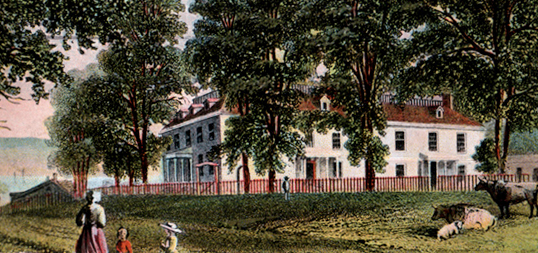
Frederick Philipse and his wife Margaret Harden Brock built the earliest section of Philipse Manor Hall in Yonkers, in the 1680's. In 1685, Frederick Philipse's ship, the “Charles,” sailed from Amsterdam to Angola on the Congo River in West Africa to exchange weapons and other goods for Africans. The Philipses were directly involved in the slave trade from 1685 to 1695. They amassed a great fortune through a profitable shipping business and extensive land acquisition, in addition to owning many slaves.
About 40 percent of households in Colonial New York owned either one or two slaves. The Philipse family, however, owned an average of least 40, more than half were specifically associated with the manor property. The Philipse required highly skilled slaves, knowledgeable in specific trades. Millers were needed to operate the grist mills, and boatmen were need to sail goods back and forth from the property to Philipse warehouse in Manhattan. Philipse slaves also worked as farmers, carpenters, and domestics. Philipse family wills and inventories insist that there were slaves of all ages and some families on the manor. Some of the slaves associated with the Lower Mills (Yonkers) portion of the property resided on the third floor of the Manor Hall.
1. Wikipedia
|
• Local History
• First Freed Slaves
|